
Mapping 25 Years of MCDM Research: A Scopus-based Analysis of Society Members (2001-2025)
Over the past 25 years, the MCDM field has evolved from a specialized niche into a globally distributed, rapidly expanding, and increasingly application-driven research field. Drawing on data from the Scopus database covering publications authored by members of the International Society on MCDM, this bibliometric analysis offers a structured snapshot of how the community has grown, where it publishes, which themes dominate its agenda, and how its geographical footprint has expanded.
Data and Search Strategy
The analysis is based on records retrieved from the Scopus database. The starting point is the list of ORCID identifiers voluntarily submitted by society members. These ORCIDs were combined in a single Scopus advanced search using a long disjunction:
- ORCID(0000-0001-….) OR ORCID(0000-0002-….) OR …
To ensure that the retrieved publications are directly related to multi-criteria and multi-objective decision analysis, the ORCID query was combined with a topic filter that targets the relevant terminology in publications:
ALL(multicriteria) OR ALL(multi-criteria) OR ALL(multiple AND criteria) OR ALL(bi-criteria) OR ALL(multi-attribute) OR ALL(multiattribute) OR ALL(multiple AND attribute) OR ALL(multi AND objective) OR ALL(multipleobjectives) OR ALL(multi-objectives) OR ALL(multiple AND objectives) OR ALL(bicriteria) OR ALL(bi-objective) OR ALL(biobjective) OR ALL(many-objective) OR ALL(vector-opimi) OR ALL(vector-maximi) OR ALL(vector-minimi)
The search was restricted to:
- Source type: journals only (SRCTYPE = “j”),
- Publication years: 2001-2025,
- Language: records indexed as English in Scopus.
This procedure yields 4,827 journal records. It is important to stress that:
- The corpus covers only members who submitted their ORCID; it does not represent the entire membership.
- The topic filter may miss some relevant work that does not explicitly use the selected terminology.
- Each publication can contribute multiple times to certain facets (e.g., several authors, multiple countries or subject areas).
The results below should therefore be interpreted as a conservative lower bound on the community’s total output and as a structured “snapshot” of its visible profile in Scopus.
1.1 Publication Output Over Time (2001-2025)
The annual number of Scopus-indexed journal publications linked to the society’s ORCID list increases from 38 in 2001 to 476 in 2025, representing more than a ten-fold rise over 25 years (see Figure 1). This corresponds to an approximate compound annual growth rate of about 10% per year.
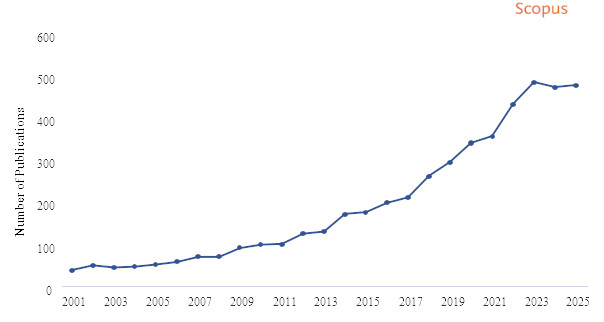
Figure 1 Number of publications per year (2001-2025)
When aggregating by five-year periods, the pattern becomes clearer, as listed in Table 1.
Table 1 Temporal distribution of Scopus-indexed publications (2001-2025)
|
Period |
Number of Publications | Percentage of Total |
| 2001-2004 | 177 | 3.7% |
| 2005-2009 | 336 | 7.0% |
| 2010-2014 | 622 | 12.9% |
| 2015-2019 | 1,137 | 23.6% |
| 2020-2025 | 2,555 | 52.9% |
| Total | 4,827 | 100.0% |
Two observations follow:
- The community’s visible journal output accelerates markedly after 2010, with a strong step-up between 2015 and 2019.
- More than half of all indexed publications in this corpus (52.9%) appear since 2020, which points to a phase of rapid expansion and consolidation in the 2020s.
Figure 1 presents the annual publication counts, showing a relatively flat baseline in the early 2000s, a steady rise from the late 2000s, and a steep incline after around 2015.
1.2 Disciplinary Profile: Scopus Subject Areas
Scopus classifies each publication into one or more subject areas. In this corpus, the distribution of subject area tags (N=10,958) is heavily concentrated in five core disciplines, which collectively represent nearly three-quarters of all assignments:
- Computer Science
- Decision Sciences
- Mathematics
- Engineering
- Business, Management and Accounting
Additional important areas are:
- Environmental Science and Social Sciences
- Energy
- Other discernible fields include Economics, Econometrics and Finance, Materials Science, and smaller contributions from Chemical Engineering and Agricultural Sciences.
This pattern indicates that the society’s members are:
- Methodologically rooted in Computer Science, Decision Sciences, and Mathematics,
- Application-oriented toward Engineering and Business/Management,
- Increasingly engaged with Sustainability, Environment, and Energy Systems.
Figure 2 illustrates a pie chart showing the share of the disciplinary profile of the publications.
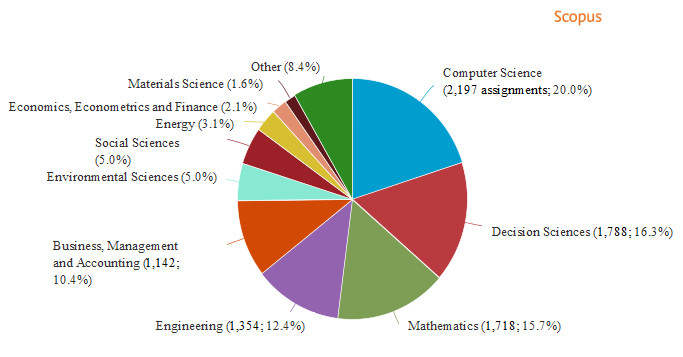
Figure 2 Disciplinary profile
1.3 Publication Venues: Journals
The corpus is restricted to journal publications. Within this set, a relatively small number of journals host a substantial share of the field’s output. The leading titles are listed in Table 2.
Table 2 Top 10 Scopus-indexed journals by number of publications
| Rank | Journal Title | Count | Focus Area |
| 1 | European Journal of Operational Research | 345 | Core OR |
| 2 | Annals of Operations Research | 127 | Core OR |
| 3 | Computers and Operations Research | 93 | Core OR |
| 4 | Sustainability | 91 | Application/Sustainability |
| 5 | Mathematics | 71 | General Mathematics |
| 6 | Omega | 70 | Core OR |
| 7 | Expert Systems with Applications | 69 | Applied AI/Decision Systems |
| 8 | Journal of Cleaner Production | 59 | Application/Sustainability |
| 9 | Journal of Multi-Criteria Decision Analysis | 58 | Specialized Decision Analysis |
| 10 | International Transactions in Operational Research | 57 | Core OR |
These outlets fall broadly into two groups:
i) Core operations research and decision analysis journals
European Journal of Operational Research, Annals of Operations Research, Computers and Operations Research, Omega, International Transactions in Operational Research, Journal of Multi-Criteria Decision Analysis, Journal of Global Optimization, Group Decision and Negotiation, Journal of the Operational Research Society, etc., which naturally align with the community’s methodological focus
ii) Application- and sustainability-oriented journals
Sustainability, Journal of Cleaner Production and others, where multi-criteria and multi-objective methods are used as tools for energy, environmental, logistics, and policy applications.
1.4 Thematic Profile: Author Keywords
Author keywords give a more detailed view of recurring topics. After excluding generic indexing terms such as “Article,” the most frequent keywords are listed in Figure 3.
These patterns confirm several aspects of the community:
- A strong focus on decision making, multi-objective optimization, and decision support systems, which are at the core of multi-criteria decision aiding.
- Significant attention to uncertainty and robustness (sensitivity analysis, fuzzy sets, risk assessment, uncertainty).
- Increasing emphasis on sustainability and sustainable development, reflecting the growing use of multi-criteria methods in environmental, energy, and socio-technical decision contexts.
Connections to operations research and optimization techniques (integer programming, linear programming, Pareto-based reasoning).
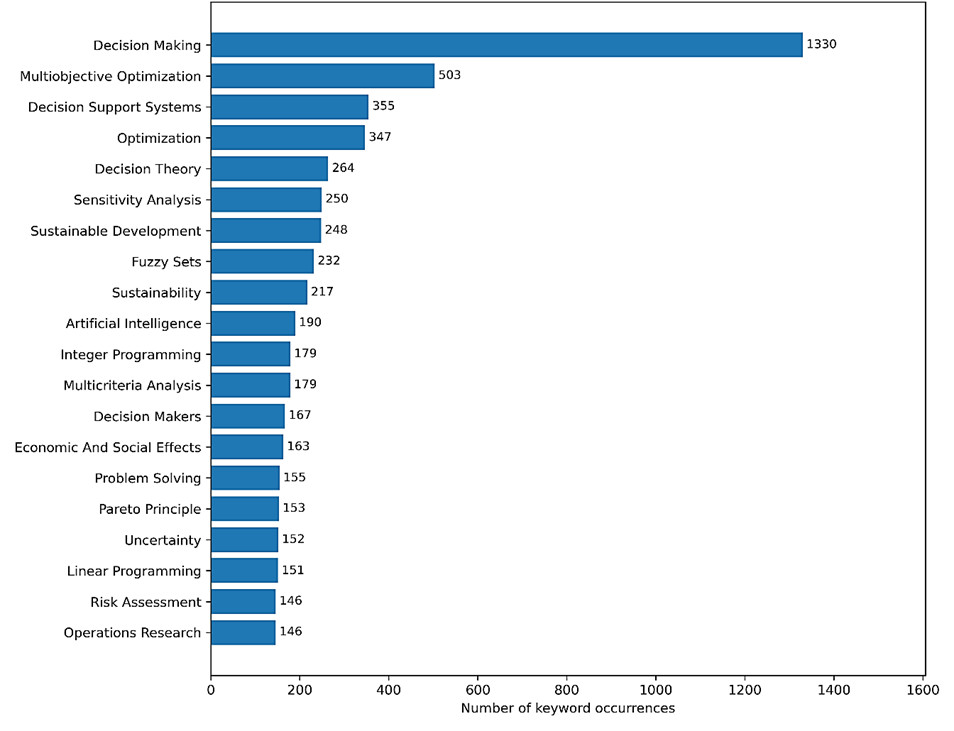
Figure 3 Top 20 author keywords
1.5 Geographical Distribution: Countries
The country facet describes the geographical distribution of the authors’ affiliations, where a single publication may involve multiple countries. As summarized in Table 3, the society’s publishing activity is strongly international. The distribution highlights a diverse network with major nodes in Europe, Asia, and the Americas.
Table 3 Top 15 countries by author affiliation count
| Rank | Country | Count | Percentage | Rank | Country | Count | Percentage |
| 1 | India | 802 | 9.4% | 9 | United States | 356 | 4.2% |
| 2 | Spain | 700 | 8.2% | 10 | Germany | 294 | 3.5% |
| 3 | Turkey | 523 | 6.2% | 11 | France | 259 | 3.0% |
| 4 | Portugal | 503 | 5.9% | 12 | China | 244 | 2.9% |
| 5 | United Kingdom | 437 | 5.1% | 13 | Saudi Arabia | 198 | 2.3% |
| 6 | Poland | 433 | 5.1% | 14 | Iran | 196 | 2.3% |
| 7 | Brazil | 405 | 4.8% | 15 | Serbia | 175 | 2.1% |
| 8 | Italy | 381 | 4.5% |
This distribution shows that the society’s publishing activity is:
- Particularly prominent in India, Spain, Turkey, Portugal, the United Kingdom, and Poland, which collectively account for a significant portion of the output (~40%),
- Complemented by contributions from countries with long OR and MCDA traditions, including Brazil, Italy, the USA, Germany, France, Finland, and Switzerland,
- Supported by emerging hubs in the Middle East and East Asia, notably Saudi Arabia, Iran, and China.
Figure 4 presents the global distribution of Scopus-indexed journal publications (2001-2025) linked to society members’ ORCIDs. The choropleth map reveals a broad geographic reach, highlighting significant research activity across Europe, Asia, the Americas, Africa, and Oceania.
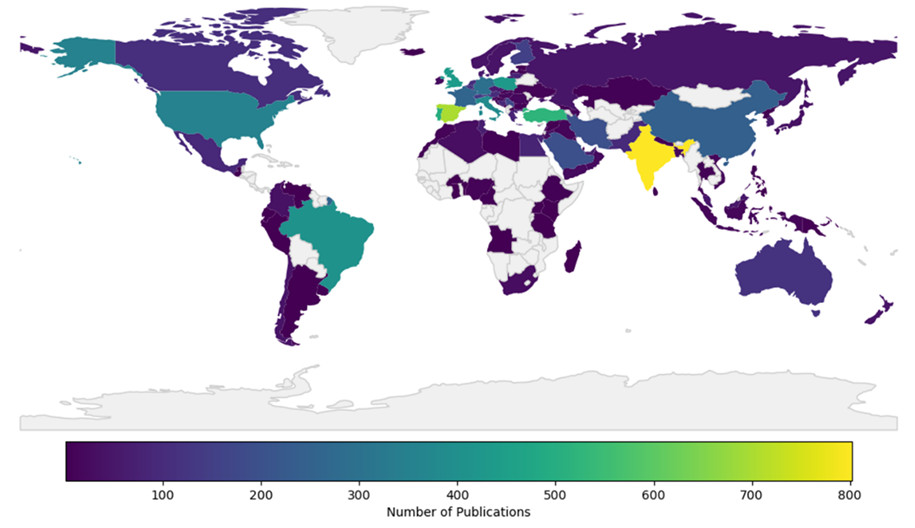
Figure 4 Geographical distribution of Scopus‐indexed journal publications (2001-2025) by country for society members who provided ORCID identifiers; countries with brighter yellow tones indicate higher publication counts, while darker purple tones indicate lower publication counts, and grey countries correspond to countries with no recorded publications in the dataset.
Summary
In summary, this Scopus-based analysis of 4,827 journal publications linked to members who submitted their ORCID codes shows:
- Rapid growth of the community’s visible output since 2001, with a particularly strong acceleration after 2015; notably, more than half of all publications have appeared within the last five years.
- A methodologically strong and application-rich profile, centered on Computer Science, Decision Sciences, Mathematics, and Engineering, with substantial engagement in environmental, social, and energy domains.
- A concentrated but diverse portfolio of journals, with core OR and decision-analysis outlets playing a central role, alongside sustainability and application-driven journals.
- A thematic focus on decision making, multi-objective optimization, decision support systems, uncertainty, and sustainability, as evidenced by author keywords.
A truly international footprint, with strong contributions from Europe, Asia, and the Americas, and a dense network of institutional hubs.
This bibliometric analysis was prepared by River Huang, who conducted the data analysis, and edited by Ece Demirer and Gülşah Karakaya.